2026-11-16 · Yujay · 9 min read
How to order food in China
If you already know 你好 and 谢谢, you can get through a meal in China. What usually trips people up is not the dish names. It is the two ways restaurants take orders, and the moment at the end when everyone else is already paying with a phone.
In many sit-down restaurants in Chinese cities, a QR code on the table opens a menu in WeChat or Alipay. You tap the dishes, send the order, and often pay on the same screen. Smaller places, some canteens, and a lot of breakfast stalls still work the older way: a server, a 菜单 (càidān, menu, HSK 3), and a bill at the end. This guide covers both, with the phrases you actually say, pinyin, and the HSK 3.0 level of each useful word from our HSK 1 and HSK 2 lists.
A short note on pinyin: 不 is written bù, but it is said bú before a fourth tone, so 不辣 is bú là. 一 is yí before a fourth tone and yì before the others, so 一个 is yí ge and 一碗 is yì wǎn. The forms below are the ones you say.
Getting a table
Staff often ask how many people you are: 几位? (jǐ wèi?). 位 (wèi) is the polite measure word for people, and it is HSK 2. Reply with 两 (liǎng), not 二, when the number is two: 两位。 (liǎng wèi.) For one person: 一位。 (yí wèi.)
If you need to ask first: 请问,有位子吗? (qǐngwèn, yǒu wèizi ma?) — Excuse me, is there a table? 请问 (qǐngwèn, HSK 1) is the usual way to start a request to a stranger.
To call a server, 服务员 (fúwùyuán) is the usual word. It is not a single HSK 3.0 entry, but it is built from 服务 (fúwù, service, HSK 3) and 员 (yuán, a person who does a job, HSK 3). 你好 (nǐ hǎo, HSK 1) plus a small wave also works. In a small shop, 老板 (lǎobǎn, boss, HSK 5) is common. Do not use 小姐 to call a waitress; it is easy to get wrong.
Reading the menu
If nobody brings a menu, ask: 有菜单吗? (yǒu càidān ma?). If you would rather hold paper than use a phone, ask for a 纸质菜单 (zhǐzhì càidān). 纸 (zhǐ, paper) is HSK 3.
Photos help, as do two HSK 1 question words: 什么 (shénme, what) and 多少 (duōshao, how much).
- 这个是什么? (zhège shì shénme?) — What is this?
- 这个多少钱? (zhège duōshao qián?) — How much is this?
- 有什么推荐? (yǒu shénme tuījiàn?) — What do you recommend? 推荐 (tuījiàn) is HSK 5.
这个 (zhège) and 那个 (nàge) are both HSK 1. Pointing plus 这个 will get you a long way.
Ordering
These three patterns cover almost every order:
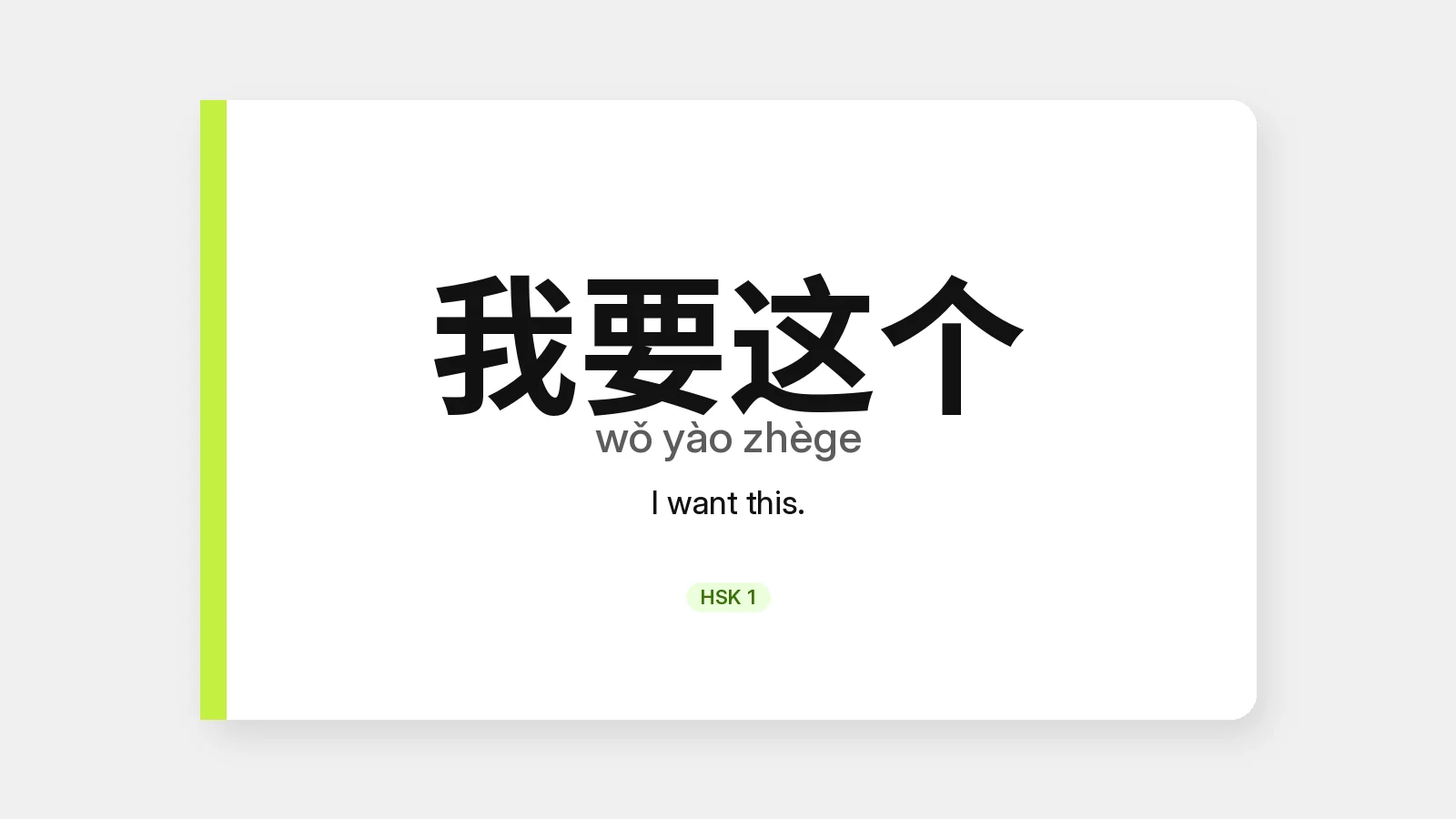
- 我要这个。 (wǒ yào zhège.) — I want this. 我, 要 and 这个 are all HSK 1.
- 来一个…… (lái yí ge…) — I'll have one… 来 (lái, HSK 1) in this pattern just means "bring".
- 点 (diǎn) — to order food. This sense of 点 is HSK 2. 我点这个。 (wǒ diǎn zhège.) — I'll order this.
Add a measure word when you can. 个 (gè, HSK 1) is the general one. For dishes, 份 (fèn, a portion, HSK 4) is more precise: 来一份鱼。 (lái yí fèn yú.) 鱼 (yú) is HSK 2. For rice and soup, use 碗 (wǎn, bowl, HSK 3): 来一碗米饭。 (lái yì wǎn mǐfàn.) 米饭 (mǐfàn, cooked rice) is HSK 1, and so is 饺子 (jiǎozi, dumplings). 包子 (bāozi, steamed stuffed buns) is also HSK 1.
To add one more: 再来一个。 (zài lái yí ge.) 再 (zài, again) is HSK 1. To drop an item: 不要这个。 (bú yào zhège.) 不要 (búyào) is HSK 1. If a dish is gone, the server says 没有 (méiyǒu, HSK 1). You can ask: 还有米饭吗? (hái yǒu mǐfàn ma?) — Do you still have rice?
Spice level
辣 (là, spicy) is HSK 4. Sichuan, Hunan and hot-pot restaurants will often ask how spicy you want the dish:
| What you say | Pinyin | Meaning |
|---|---|---|
| 不辣 | bú là | no chilli |
| 微辣 | wēi là | a little spicy |
| 中辣 | zhōng là | medium |
| 特辣 / 很辣 | tè là / hěn là | very spicy |
微 (wēi, slightly) is HSK 7–9, but 微辣 is the phrase you will see on menus. 很 (hěn, very) is HSK 1. If you do not like chilli, say 不辣 when you order, not only when the food arrives. For hot pot (火锅, huǒguō, HSK 5), people often split the pot: one side 不辣, one side spicy.
麻辣 (málà, numbing and spicy) is HSK 7–9. If you do not want Sichuan peppercorn, say 不要麻。 (bú yào má.)
Dietary needs
Be specific. 我吃素。 (wǒ chī sù.) — I am vegetarian — will be understood, but 素 (sù) is HSK 7–9, and in many kitchens a "vegetarian" dish may still use meat stock, egg or lard. Safer lines:
- 不要肉。 (bú yào ròu.) — No meat. 肉 (ròu) is HSK 2.
- 不要鸡肉,不要猪肉。 (bú yào jīròu, bú yào zhūròu.) — No chicken, no pork. 鸡 (jī) is HSK 3; 猪 (zhū) is HSK 5. The compounds 鸡肉 and 猪肉 are everyday words, not separate HSK entries.
- 我不吃猪肉。 (wǒ bù chī zhūròu.) — I do not eat pork. Say this at the start. For a halal kitchen, look for 清真 (qīngzhēn) on the sign; that word is not in the HSK 3.0 list, but the sign is.
- 我对花生过敏。 (wǒ duì huāshēng guòmǐn.) — I am allergic to peanuts. 过敏 (guòmǐn) is HSK 5; 花生 (huāshēng) is HSK 6.
Coriander is a common garnish and is not in the HSK list. If you do not want it, memorise 不要香菜 (bú yào xiāngcài) as a chunk. The same pattern works for garlic: 蒜 (suàn, HSK 7–9), 不要蒜。
Drinks and everyday dishes
水 (shuǐ, water) and 茶 (chá, tea) are HSK 1. 冰 (bīng, ice) is HSK 3; 热 (rè, hot) is HSK 1. 来一杯热水。 (lái yì bēi rèshuǐ.) — A cup of hot water. 杯子 (bēizi, cup) is HSK 1. 来一杯茶。 (lái yì bēi chá.) 冰的。 (bīng de.) — Iced. 常温。 (chángwēn, HSK 6) — room temperature, no ice. 啤酒 (píjiǔ, beer) is HSK 3; 咖啡 (kāfēi, coffee) is HSK 2.
The food sense of 面 (miàn, noodles) is HSK 5; people usually say 面条 even though that compound is not a separate list entry. 豆腐 (dòufu, tofu) and 火锅 are HSK 5. Famous names such as 宫保鸡丁, 麻婆豆腐 and 小笼包 are not HSK entries. Learn them as names, or point to the photo and say 我要这个.
QR-code ordering
In a typical sit-down restaurant the code is on the table. Open WeChat or Alipay, tap Scan, and point the camera at it.
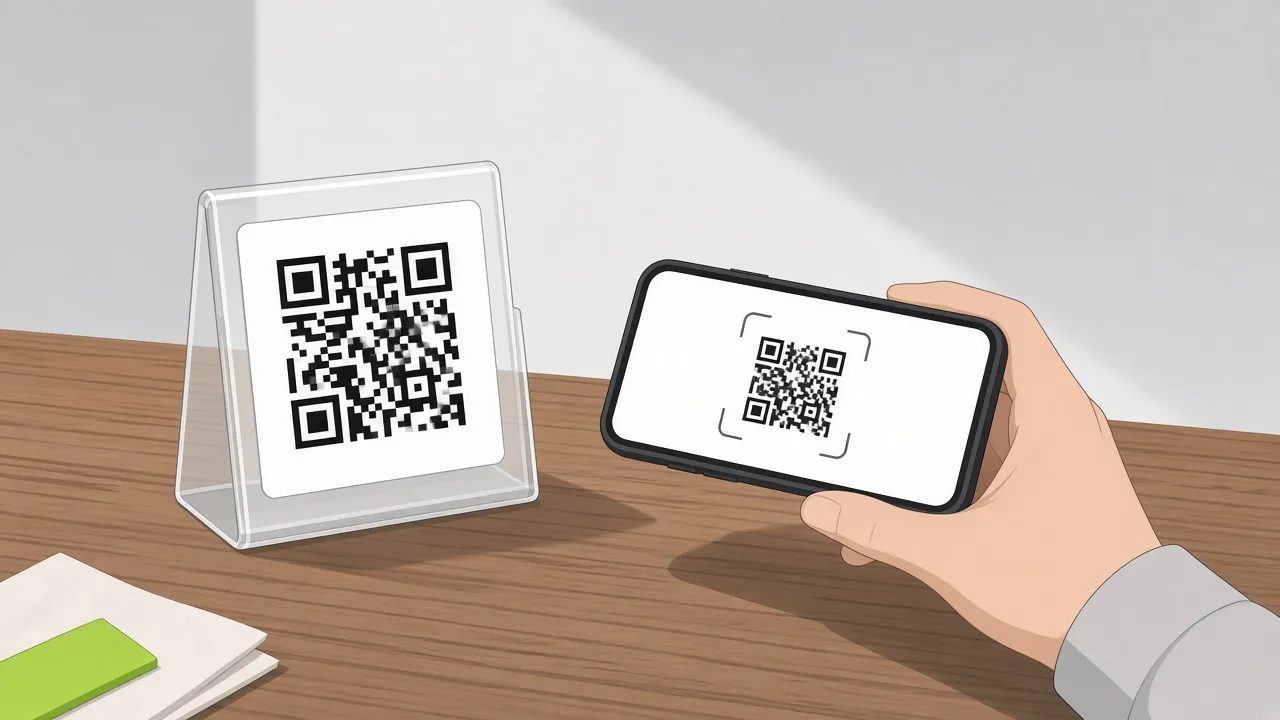
A table code is often a menu, not a payment code. It usually opens a mini program: you confirm the table number, add dishes, and submit. Payment may be asked for immediately, or only when you are done. Check the table number and the restaurant name before you submit.
The page may also ask you to sign in. Some menus open in a browser; many only work inside WeChat or Alipay. A few still ask for a Chinese phone number. If you cannot get past the first screen, ask the staff: 我不会用,可以帮我点吗? (wǒ bú huì yòng, kěyǐ bāng wǒ diǎn ma?) — I cannot use this; could you order for me? Or ask for a paper menu.
扫码 (sǎomǎ, to scan a QR code) is HSK 4; 二维码 (èrwéimǎ, QR code) is HSK 5. Signs that say 扫码点餐 mean "scan to order". Street stalls and small noodle shops may have no code at all. Order out loud, then pay at the counter.
Paying
The everyday thing people say is 买单 (mǎi dān). It is not a listed HSK 3.0 word. The word on the syllabus is 结账 (jiézhàng, to pay the bill, HSK 4). Both are understood in a restaurant.
- 买单。 / 结账。 — The bill, please.
- 可以扫码吗? (kěyǐ sǎomǎ ma?) — Can I pay by QR code?
- 有发票吗? (yǒu fāpiào ma?) — Can I have a receipt? 发票 (fāpiào) is HSK 6; you only need it if someone will reimburse the meal.
Cash (现金, xiànjīn, HSK 4) still works at many small places, but a lot of restaurants now expect a phone. Credit cards (信用卡, xìnyòngkǎ, HSK 3) are uncommon outside hotels and big chains.
For visitors, the practical setup is: install Alipay and WeChat before you travel, register with your own phone number, and link an eligible international bank card. Visa, Mastercard, American Express, JCB, Discover, Diners Club and UnionPay are the networks usually listed. You can then pay in two ways: scan the merchant's code, or open your own payment code and let the cashier scan it. Both are normal. Alipay often has a clearer English interface; WeChat is the app more restaurant menus live inside, so having both is useful.
A foreign card can still be declined. Check the amount on the confirmation screen, including any service fee, before you approve. Personal collection codes (a private QR from someone's wallet, not a merchant till) often fail with a foreign card; if one direction does not work, try the other, or pay cash. Keep a physical card and some yuan (元, yuán, HSK 1; in speech often 块, kuài, also HSK 1) as a backup, and make a tiny test payment before you are hungry.
Taking food away
打包 (dǎbāo, to pack leftovers, HSK 5) is the word you want: 可以打包吗? (kěyǐ dǎbāo ma?) — Can I take this away? Or just 打包。 外卖 (wàimài, takeout or delivery, HSK 3) is the wider word, including delivery apps. In the restaurant, say 打包.
A small set to learn first
If you only memorise a handful, make it these: 你好, 请问, 几位, 菜单, 我要这个, 来一个, 不辣, 不要肉, 买单, 可以打包吗, and 谢谢. Most of that list is already on the HSK 1 word list; 菜单, 不辣 and 打包 come in a little later, but you will use them on day one. The rest you can look up as you go: every word above that has a level sits on its own page, with pinyin, an example and audio. When a dish photo is already on the table, 我要这个 will do the rest.